
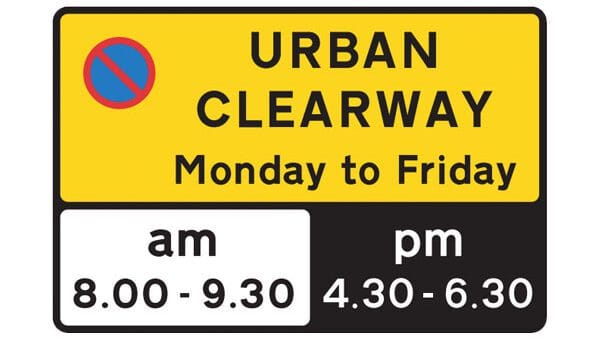
An Urban Clearway is a section of road in urban areas where stopping and parking are restricted, usually during specific times, to improve traffic flow and reduce congestion.
These areas are marked by official road signs indicating the restrictions, and during the hours of operation, drivers are generally allowed to stop only to pick up or drop off passengers — and only for as long as it takes for the passenger to get in or out of the vehicle.
Failing to follow Urban Clearway rules can lead to fines, penalty points, and even the removal of your vehicle. Understanding how these zones work is essential for safe and legal driving in busy towns and cities.
What is an Urban Clearway?
An Urban Clearway is a designated section of a road where stopping, parking, and sometimes loading or unloading vehicles are restricted or prohibited during certain times of the day. The goal is to keep traffic moving smoothly, particularly during peak hours when congestion is at its worst.
Key facts about Urban Clearways:
Location: Common in busy towns and cities, especially on main roads leading in and out of centres.
Markings: No special road markings — instead, the restrictions are shown using clearly placed signs along the route.
Times of operation: Shown on the signs. Restrictions usually apply during peak times (e.g., 8:00–9:30am and 4:30–6:30pm), Monday to Friday.
What’s allowed: You can stop briefly to pick up or drop off passengers but you must not wait, park, or load/unload.
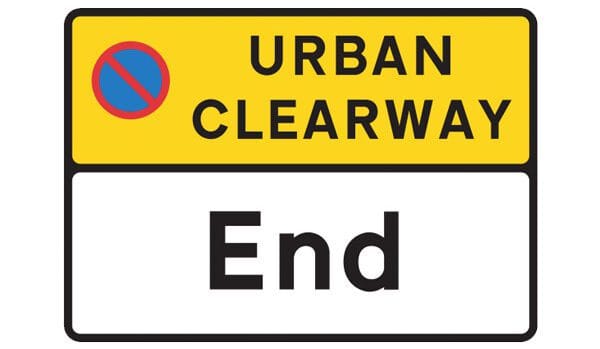
End of zone: Marked by a sign reading “End” below the Urban Clearway header.
Urban Clearways exist because even short-term parking in the wrong place during busy hours can cause bottlenecks, delays, and accidents.
Urban Clearway Sign and What It Means
The Urban Clearway sign has a yellow background with the words “URBAN CLEARWAY” in black. Above the text is the familiar no stopping symbol — a blue circle with a red cross through it. Below, the sign shows the days and times the restrictions apply.
For example:
AM: 8:00–9:30
PM: 4:30–6:30
Outside these times, normal parking rules apply, but you should still check for other restrictions in the area, such as Pay & Display zones.
At the end of the restricted stretch, you’ll see a white sign with “End” under the same Urban Clearway header.
What Are Clearway Restrictions?
Clearway restrictions refer to the rules and regulations in place for a specific type of road sign that indicates no stopping or parking is allowed. The exact restrictions depend on the type of clearway sign displayed.
24-hour Clearway
One of the most common types of clearway sign is the 24-hour clearway, also known as a no-stopping sign. This sign features a blue circle with a red cross in the centre, indicating that stopping or parking is not allowed at any time.
In some cases, 24-hour clearways are also referred to as rural clearways, as they are often used on roads outside of urban areas. However, many urban roads without direct frontages also make use of the 24-hour clearway sign.
Red Route Clearway
Another type of clearway sign is the red route clearway. These are major roads in London managed by Transport for London (TfL). They are identified by red lines along the edges of the road.
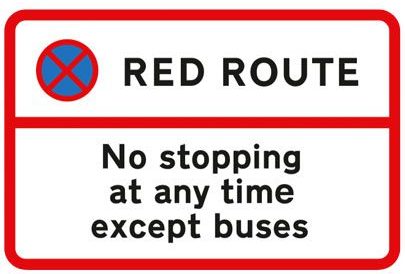
Red route clearways are indicated by a sign featuring a red cross on a blue background. These restrictions typically apply 24/7 and are enforced by TfL’s traffic enforcement officers.
What is a Red Route?
A Red Route Clearway, or simply Red Route, is a traffic management measure used mainly in London to keep busy roads moving.
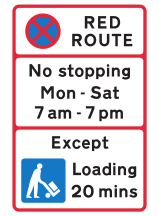
Markings: Red lines along the kerb edge.
Restrictions: No stopping, parking, or loading/unloading at any time, except for buses at designated stops.
Purpose: To reduce congestion on major arterial routes.
Enforcement: Regular patrols and CCTV monitoring.
If you see a red route clearway sign, stopping is prohibited — even to pick up or drop off passengers — unless you are at a designated stop.
Urban Clearway Rules and Restrictions
When driving in an Urban Clearway during its hours of operation:
You may stop only to pick up or drop off passengers.
You may not wait, park, or load/unload goods.
You must move off immediately after passengers have entered or exited.
You must obey the times shown on the sign — they are legally enforceable.
Always check for additional parking restrictions outside Urban Clearway times.
Violations can result in penalty charge notices (PCNs), fines (often £70–£130 depending on the council), and possible towing.
Where Will You See Urban Clearways?
Urban Clearways are typically placed in:
Main commuter roads into city centres.
Busy shopping districts where parking could block through traffic.
Near schools or transport hubs where congestion is likely during peak times.
Routes used by emergency services where access must be maintained.
How to Identify an Urban Clearway
Look for:
The yellow Urban Clearway sign with the no-stopping symbol and the restricted times listed.
Repeater signs along the route to remind drivers of the restriction.
The ‘End’ sign marking the conclusion of the restricted stretch.
Unlike some restrictions, there are no painted road markings to indicate an Urban Clearway. The signs are your only clue, so missing them could result in an unintentional offence.
Top Tip for Drivers
Where you see an Urban Clearway sign in operation, you’ll often find it’s also within a Pay & Display zone outside the restricted hours.
In London and other busy cities, check if nearby cars have tickets displayed (though many areas now require phone payment instead).
Maximum stays are usually between 2–4 hours in these areas.
Never assume free parking outside the restricted times — always check the nearest parking sign.
Why Urban Clearways Are Important
Urban Clearways help:
Keep traffic flowing during the busiest parts of the day.
Reduce congestion in areas with limited road space.
Improve safety for cyclists, pedestrians, and other drivers.
Ensure emergency vehicles can pass without obstruction.
They are particularly valuable in cities with narrow roads where even one parked car can cause delays and hazards.
Urban Clearway vs. Other Restrictions
Urban Clearway
No stopping during set times (except passenger drop-off/pick-up).
Common in busy urban roads.
No special road markings — signs only.
Clearway (24-hour)
No stopping at any time.
Common in rural and urban roads without frontages.
Sign: Blue circle with red cross.
Red Route
No stopping at any time (except buses in designated bays).
Found on key arterial roads in London.
Marked by red lines along the kerb.
Penalties for Ignoring Urban Clearway Rules
Breaking Urban Clearway restrictions can result in:
Penalty Charge Notice (PCN): Usually £70–£130.
Towing: Your vehicle may be removed if it’s causing an obstruction.
Points on your licence (in rare cases where obstruction causes danger).
CCTV and traffic wardens frequently monitor Urban Clearways during restricted hours, so enforcement is strict.
Summary
Urban Clearways are designed to improve traffic flow and reduce congestion during peak hours in busy areas. They’re easy to identify if you know the signs, but easy to miss if you’re distracted. Always read the restriction times carefully and remember — you can only stop briefly to pick up or drop off passengers, never to wait or park.
Understanding the difference between Urban Clearways, 24-hour clearways, and Red Routes is essential for every driver, particularly in busy UK cities.
Top Tip for Urban Clearways 👨🏫
“Urban Clearway signs can be a bit misleading for new drivers—just because you can stop outside of the restricted hours doesn’t mean it’s free parking. In most busy areas, especially in parts of London, you’ll still need to pay to park and follow time limits.
Don’t assume it’s okay just because other cars are parked—many use phone-based parking apps, so you might not see a paper ticket. Always check nearby signs carefully for time limits, payment instructions, and any hidden restrictions.
Spaces in these zones are often limited to short stays, usually between 2 to 4 hours, so set a reminder to avoid a penalty.”
Shorif Kazi – DVSA Approved Driving Instructor
Urban Clearway FAQ's
An Urban Clearway is a road section in urban areas where stopping and parking are restricted during certain times to keep traffic flowing.
Yes, but only to pick up or drop off passengers — you must move off immediately.
No. Loading and unloading are not allowed during restricted times.
Look for the “End” sign under the Urban Clearway header.
No. Restrictions are shown only on signs — there are no painted road markings.
Times vary but are shown on the sign, often covering peak hours like 8:00–9:30am and 4:30–6:30pm.
You may receive a Penalty Charge Notice (PCN) and, in some cases, your vehicle could be towed.
No. Red Routes usually prohibit stopping at all times and are marked with red lines along the kerb.
Yes, if stated on the sign — always check the displayed days and times.
Urban Clearways are mainly in cities, but similar rules can apply on busy suburban or commuter roads.