
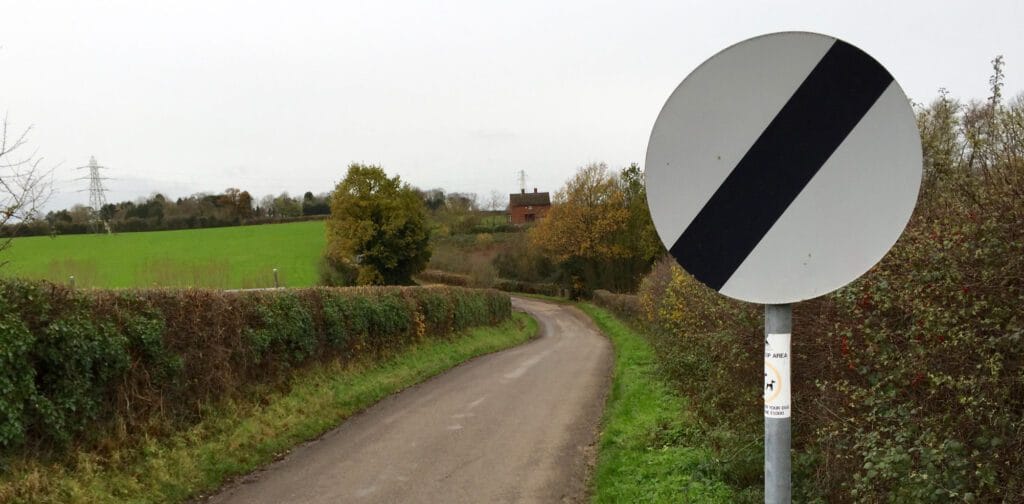
Quick summary
The national speed limit in the UK is not one single number. It changes depending on the type of road you are on and the type of vehicle you are driving, which is why the national speed limit sign does not always mean 70 mph. For most learner drivers in a standard car, the key limits are 60 mph on a single carriageway and 70 mph on a dual carriageway or motorway, but there are important exceptions you need to know.
What is the national speed limit in the UK?
The phrase “national speed limit” sounds simple, but it catches out a lot of learners because it is really a framework, not just one speed. The official GOV.UK speed limits guide and Highway Code Rule 124 both make the same basic point: the maximum speed depends on the road and the vehicle.
For a standard learner car, the national speed limit usually means 60 mph on a single carriageway and 70 mph on a dual carriageway or motorway. That is the part most learners remember. The mistake is assuming the black diagonal national speed limit sign always means 70 mph, when in reality it only means the default national limit now applies for that road and that class of vehicle.
That is why speed-limit questions come up so often in lessons and theory revision. If you are already working on use of speed, this is one of the first areas where knowing the rule is only half the job. The other half is recognising the road correctly and adjusting your speed to the conditions instead of just chasing the maximum number on the sign.
What does the national speed limit sign mean?
The national speed limit sign guidance explains that the sign means the national speed limit for that type of road and class of traffic applies. In plain English, that means the sign is telling you to switch from a locally signed limit, such as 40 or 50, back to the default legal maximum for the road you are now on.
That is why the sign itself does not tell you the exact mph. You still need to know whether the road is a single carriageway, a dual carriageway or a motorway, and whether your vehicle has a different limit from a normal car. Learners who get this wrong often do so because they focus on the sign but not on the road layout.
Why the national speed limit is not a target
The Highway Code is also clear that the speed limit is the absolute maximum, not a target. That matters because a wet country road, poor visibility, sharp bends or heavy traffic can make the legal maximum too fast for the conditions.
This is a big point for learners because examiners are not looking for someone who always drives at the top of the limit. They are looking for someone who can read the road, stay safe and make sensible decisions. That is one reason many people find professional lessons worthwhile, especially when they are comparing driving instructors near you and trying to build safer habits from the start.
National speed limit UK rules for cars
For most Rated Driving readers, the most useful version of this topic is the one that focuses on a normal car. These are the limits learner drivers need to know first.
Single carriageway national speed limit
For cars and motorcycles, the national speed limit on a single carriageway is 60 mph under Highway Code Rule 124. This is the limit that learners most often misread because they see the national speed limit sign and assume the road is 70 mph.
A single carriageway is not defined by how many lanes it has. It is defined by the lack of a central reservation separating traffic going in opposite directions. So a wide road with two lanes in your direction can still be a single carriageway if there is no physical divider in the middle. That is why identifying the road properly matters more than guessing from width alone.
Single carriageways are also where good judgement matters most. A straight, open rural road may legally allow 60 mph, but blind bends, tractors, cyclists, horses or poor weather can mean a much lower safe speed. That is exactly the kind of judgement learners sharpen when they are preparing for test situations and working through common mistakes learner drivers should avoid.
Dual carriageway national speed limit
For cars and motorcycles, the national speed limit on a dual carriageway is 70 mph. The key feature of a dual carriageway is a central reservation dividing traffic travelling in opposite directions. It does not have to be a huge barrier or crash wall. Even a grass strip or metal barrier separating the two directions is enough.
This matters because the national speed limit sign on a dual carriageway means something different from the same sign on a single carriageway. The sign has not changed, but the road type has. For learners, that is one of the clearest examples of why the national speed limit is about context, not just memorising one number.
It is also a common theory-test area. If you are revising signs and speed-limit rules, our guide on how to prepare for your theory test is a good companion read because it helps connect the rulebook with the kind of questions learners actually face.
Motorway national speed limit
For cars and motorcycles, the national speed limit on a motorway is also 70 mph. That sounds simple, but learners still need to remember that a variable speed limit can temporarily replace it. If a sign above the carriageway shows a lower speed inside a red circle, that lower limit is the one you must follow.
The official speed limit signs guidance also explains that variable limits are used on some motorways and dual carriageways. So even when the usual national limit would be 70 mph, the live sign takes priority if a lower number is displayed.
| What you need to know | Details |
|---|---|
| What the national speed limit sign means | The default legal limit now applies for that road and vehicle |
| Car on a single carriageway | 60 mph |
| Car on a dual carriageway | 70 mph |
| Car on a motorway | 70 mph |
| Roads with street lights and no signs | Usually 30 mph in England, Scotland and Northern Ireland |
| Restricted roads in Wales | Usually 20 mph unless signs show otherwise |
| Car towing a trailer or caravan | 50 mph on single carriageways, 60 mph on dual carriageways and motorways |
| Most goods vehicles up to 7.5 tonnes | 50 mph on single carriageways, 60 mph on dual carriageways, 70 mph on motorways |
| Learner drivers on motorways | Only with an ADI in a dual-controlled car |
| Minimum speeding penalty | £100 fine and 3 penalty points |
How to tell what speed limit really applies
Knowing the rule is one thing. Spotting the correct limit in real traffic is the part that separates confident learners from unsure ones.
How to tell if a road is single or dual carriageway
The fastest way to identify the right national speed limit is to look for a central reservation. If traffic travelling in the opposite direction is separated from you by a barrier, kerb, grass strip or central island, it is a dual carriageway. If opposing traffic is simply on the other side of painted road markings, it is a single carriageway.
This is where many new drivers hesitate, especially on wider A roads that feel fast enough to be 70. A road can look like a dual carriageway and still be a single carriageway if there is no central reservation. Getting this right early can save a lot of confusion in lessons, especially if you are still deciding between manual or automatic driving lessons and want to reduce the number of things you are juggling at once.
Street lights, built-up areas and Wales
Another area that causes confusion is roads with street lights. The GOV.UK speed limits guide says that a limit of 30 mph usually applies on roads with street lights, unless signs show otherwise. In Wales, the default on restricted roads is 20 mph, following the Welsh Government’s 20 mph guidance.
For learners, the practical takeaway is simple. If you are on a road with regular street lighting and there are no signs telling you something different, do not assume national speed limit means 60 or 70. In England, Scotland and Northern Ireland that usually means 30 mph, and in Wales it is usually 20 mph on restricted roads unless signed otherwise.
National speed limit for other vehicle types
Most learners start in a normal car, but some people practise in a family van or later tow a trailer. That is where vehicle-specific limits become important.
Cars, motorcycles and car-derived vans
Under Highway Code Rule 124, cars and motorcycles follow the standard 60 mph single carriageway and 70 mph dual carriageway and motorway limits. Car-derived vans up to 2 tonnes maximum laden weight also fall into this group, which is why some smaller vans have the same limits as cars.
That said, learners should be careful about assuming all vans are treated the same. If the vehicle is not car-derived or falls into a different class, the limit may be lower. This is one of those details that is easy to overlook when you are still focused on the basics of clutch control, signs and junctions.
Cars towing trailers and most larger vans
The Highway Code table is clear that cars towing caravans or trailers have lower national speed limits: 50 mph on single carriageways and 60 mph on dual carriageways and motorways. Goods vehicles not exceeding 7.5 tonnes maximum laden weight also have lower limits than a normal car on single and dual carriageways.
That is why the safest approach is to think about both the road and the vehicle before relying on the sign alone. For most learner-car readers, the main takeaway is still the standard car rule, but if you ever move into a different vehicle class, check the official table first rather than assuming the car limit still applies.
What learner drivers need to know about the national speed limit
The national speed limit is not just theory-test content. It affects real lessons, motorway training and the way you are judged on safe driving.
Speed-limit knowledge and the driving test
On test, you are expected to recognise the correct limit and make sensible progress within it. Driving too fast is clearly dangerous, but driving much too slowly for no reason can also create problems because it shows weak observation or poor judgement.
That is why national speed limit knowledge sits alongside wider speed control. It is not just about remembering that single carriageway equals 60 and dual carriageway equals 70. It is about choosing a safe, appropriate speed for the road ahead. That is also why so many learners revisit what you can expect on your first driving lesson and then build toward more advanced judgement as their lessons progress.
Can learner drivers go on motorways?
Yes, but only in a specific setup. The official learner-driver motorway guidance says learners can drive on motorways only when accompanied by an approved driving instructor in a car fitted with dual controls.
That makes motorway lessons a good example of how speed-limit knowledge and instructor choice fit together. If you are not sure what qualifies someone to teach you, our guide to what an Approved Driving Instructor (ADI) is explains it clearly, and our guide on dual control cars covers why the car setup matters. Private practice with friends or family does not allow motorway driving for learners.
Common national speed limit mistakes
A strong page on the national speed limit should deal with the mistakes learners actually make, not just repeat the table.
Assuming the national speed limit sign means 70 mph
This is the biggest one. The sign does not mean “you may now drive at 70.” It means the default national limit for that road and that vehicle now applies. On a single carriageway in a car, that means 60 mph, not 70 mph.
Forgetting that local and variable limits override the default
The national speed limit only applies when no lower signed limit is in force. If you pass into a 40 zone, enter a village with a 30 sign, or see a live motorway sign with 50 in a red circle, that signed limit overrides the default.
Driving at the limit when conditions do not support it
The legal maximum is not always the safe speed. Learners often improve fastest when they stop treating the speed limit like a goal and start treating it like a ceiling. That is one reason many readers eventually ask whether driving lessons are worth it, because good instruction helps turn rule knowledge into safer judgement.
What happens if you break the national speed limit?
The official speeding penalties page says the minimum penalty for speeding is a £100 fine and 3 penalty points. In more serious cases, fines can be higher and you can be disqualified.
This matters even more for newly qualified drivers. The same official guidance says that if you are within two years of passing your test and build up 6 or more penalty points, your licence can be revoked. For a new driver, that can turn one bad speeding decision into a much bigger setback.
For learner drivers, that is the right mindset to finish with: the national speed limit is not just a number to memorise for theory revision. It is a legal rule, a safety boundary and a judgement test all at once. Learn it properly now, and the rest of your driving starts to make more sense.
FAQ's
No. The national speed limit sign means the default limit for that road and that type of vehicle now applies. In a standard car that means 60 mph on a single carriageway and 70 mph on a dual carriageway or motorway.
For cars and motorcycles, the national speed limit on a single carriageway is 60 mph. Many learners get this wrong because they see the national speed limit sign and assume the road must be 70 mph, but that only applies on dual carriageways and motorways.
For a standard car, the national speed limit on a dual carriageway is 70 mph. The important thing is recognising the central reservation, because that is what makes it a dual carriageway rather than a wide single carriageway.
Look for a central reservation separating traffic travelling in opposite directions. If there is no divider and oncoming traffic is only separated by road markings, it is a single carriageway even if the road looks wide.
Yes, in one important way. On restricted roads with street lights, Wales introduced a default 20 mph limit, so learners should not assume the usual 30 mph rule applies everywhere in the UK.
Yes, but only with an approved driving instructor in a dual-controlled car. Our pages on what an ADI is and dual control cars explain why both of those conditions matter.
Not always. Some car-derived vans share the same limits as cars, but many goods vehicles have lower limits on single and dual carriageways, so it is important to check the vehicle class rather than guessing.
Yes, both directly and indirectly. The theory test can ask about signs and speed rules, and on the practical test you are expected to recognise the correct limit and use safe speed judgement, which is why how to prepare for your theory test is worth covering properly.
The minimum penalty is usually 3 points and a £100 fine, but it can be more serious depending on the offence. If you are within two years of passing and reach 6 or more points, you can lose your licence and have to start the process again.
Start by learning the road-type rules properly, then practise spotting single and dual carriageways in real traffic with a qualified instructor. Many learners improve faster when they combine that with guided reading on use of speed and compare driving instructors near them who focus on building judgement, not just ticking off manoeuvres.